Sunday, 12 February 2012

muslim marriage


Marriage customs vary in Muslim dominated countries. Cultural customs are sometimes implemented under the cover of Islam. However Islamic law allows limited polygyny under strict conditions.
Islamic jurists have traditionally held that Muslim women may only enter into marriage with Muslim men,[70] On the other hand, the Qur'an allows Muslim men to marry women of the People of the Book, a term which includes Jews and Christians, but they must be chaste. However, fiqh law has held that it is makruh (reprehensible, though not outright forbidden) for a Muslim man to marry a non-Muslim woman in a non-Muslim country.      [70] Notable scholar Bilal Philips has said the verse that permits Muslim men to marry non-Muslim women is not valid anymore today due to several reasons including its misunderstood interpretation.[71] One explanation for marriage restrictions is that they are pursuant to the principle that Muslims may not place themselves in a position inferior to that of the followers of other religions.[72]
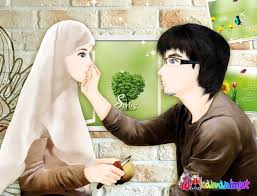
Marriage within some predominantly Muslim countries still retains practices from pre-Islamic times. Endogamy, virilocality and polygyny are practiced in some Islamic countries. In some countries, however, polygamy is outlawed or restricted by new family codes; for example the Moudawwana in Morocco.[73]Polygamy is permitted under restricted conditions,[74] but it is not widespread.[75] However, it is strongly discouraged in the Qur'an, which says, 'do justice to them all, but you won't be able to, so don't fall for one totally while ignoring other wife(wives)'. This also must be taken in historical context, as this was actually a restriction on the number of wives men of the Arabian tribes can take. Sometimes Pre-Islamic men had up to eight wives. Women are not allowed to engage in polyandry, whereas men are allowed to engage in polygyny.[74]
A marriage of pleasure, where a man pays a sum of money to a woman or her family in exchange for a temporary spousal relationship, is an ancient practice that has been revived in Iraq in recent years. Its practitioners cite sharia law as permitting the practice. Women's rights groups have condemned it as a form of legalized prostitution.[76] This type of marriage is strictly prohibited in Sunni Islam. [77]

muslim girl education


Historically, women played an important role in the foundation of many Islamic educational institutions, such as Fatima al-Fihri's founding of the University of Al Karaouine in 859 CE. This continued through to the Ayyubid dynasty in the 12th and 13th centuries, when 160 mosques and madrasahs were established in Damascus, 26 of which were funded by women through the Waqf (charitable trust or trust law) system. Half of all the royal patrons for these institutions were also women.[26]
According to the Sunni scholar Ibn Asakir in the 12th century, there were various opportunities for female education in what is known as the medieval Islamic world. He writes that women could study, earn ijazahs (academic degrees), and qualify as scholars (ulamā’) and teachers. This was especially the case for learned and scholarly families, who wanted to ensure the highest possible education for both their sons and daughters.[27] Ibn Asakir had himself studied under 80 different female teachers in his time. In nineteenth-century West Africa, Nana Asma’u was a leading Islamic scholar, poet, teacher and an exceptionally prolific Muslim female writer who wrote more than 60 works. Female education in the Islamic world was inspired by Muhammad's wives: Khadijah, a successful businesswoman, and Aisha, a renowned hadith scholar and military leader. The education allowed was often restricted to religious instruction. According to a hadith attributed to Muhammad, he praised the women of Medina because of their desire for religious knowledge:[28]
"How splendid were the women of the ansar; shame did not prevent them from becoming learned in the faith."
While it was not common for women to enroll as students in formal classes, it was common for women to attend informal lectures and study sessions at mosques, madrassas and other public places. For example, the attendance of women at the Fatimid "sessions of wisdom" (majālis al-ḥikma) was noted by various historians including Ibn al-Tuwayr and al-Muṣabbiḥī.[29] Similarly, although unusual in 15th-century Iran, both women and men were in attendance at the intellectual gatherings of the Ismailis where women were addressed directly by the Imam.[30]
While women accounted for no more than one percent of Islamic scholars prior to the 12th century, there was a large increase of female scholars after this. In the 15th century, Al-Sakhawi devotes an entire volume of his 12-volume biographical dictionary Daw al-lami to female scholars, giving information on 1,075 of them.[31]
Recently there have been several female Muslim scholars including Sebeca Zahra Hussain who is a prominent female scholar from the Sunni sect.

women in islam

The study of women in Islam investigates the role of women within the religion of Islam.[1] The complex relationship between women and Islam is defined by Islamic texts, the history and culture of the Muslim world.[2] The Qur'an states that both men and women are equal,[3][4][5] but also, as in 4:34, that "Men are the protectors and maintainers of women, because Allah has made one of them to excel the other, and because they spend from their means. Therefore the righteous women are devoutly obedient and guard in the husband's absence what Allah orders them to guard." Although the Quran does say this, the superiority of men is interpreted in terms of strength by the context - men maintain women.[6]
Sharia (Islamic law) provides for complementarianism,[7] differences between women's and men's roles, rights, and obligations. However neither the Quran nor Hadith mention women have to be housewives.[8][9][10] Majority Muslim countries give women varying degrees of rights with regards to marriage, divorce, civil rights, legal status, dress code, and education based on different interpretations. Scholars and other commentators vary as to whether they are just and whether they are a correct interpretation of religious imperatives.